 Lou Bichard
Beyond code assistants to AI software engineers
Code assistants are transitional technology, like Blu-ray or Blackberry. The next decade belongs to organizations running autonomous AI software engineers 24/7 on legacy work.
I've just got back from re:Invent 2025, where I had many conversations in the conference about how Ona is different from code assistants. It's a fair question given your company has likely rolled out Copilot, Cursor or Claude Code. While Ona integrates very well with code assistants already, we believe: code assistants are a transitional technology.
Like Blu-ray and Blackberry we believe that code assistants will be useful for a short while, but their utility will fade. Deploying code assistants was not a mistake, it was a necessary first step for many organizations to use AI in software. That said, with recent innovations, coding agents can now work autonomously for longer periods of time, opening up far more ambitious possibilities that code assistants can't achieve due to their design.
The real work is in legacy, not in greenfield
The challenge with code generation is that most large enterprises don't need more code. They need to deal with the code they already have. But 95% of that work is below the surface, it’s the work that nobody wants to talk about, and nobody wants to do, like:
- Getting your 200 microservices updated from Java 8 to Java 17
- Migrating every last repo from Gitlab to GitHub
- Patching security vulnerabilities across your organization
- Updating documentation that's perpetually out of date
It's boring, it’s tedious, but it’s necessary to keep the lights on and our organizations can’t function without this legacy code. It’s propping up the entire company. From banking systems to airline applications. It’s organizational-scale work, it won’t be solved ‘one developer at a time’ by making each developer marginally faster using a code assistant.
The answer is to start building a hybrid workforce
A hybrid workforce is one where human engineers focus on architecture, strategy, product thinking, and judgment calls while AI software engineers handle execution, operations, modernization, and toil. Not replacing people, or engineers but reorganizing our systems and organizations for a new form of work. Where engineers are redirected onto creative work, offloading ‘undifferentiated heavy lifting’ work to AI software engineers.
AI software engineers, unlike code assistants:
- Work 24/7/365 without breaks - triggered to act on schedules or by events
- Generate, but also review, remove, remediate and update code
- Work ‘on the go’ delegated to from your laptop or mobile device
- Operate in parallel across every repository in your organization
- Secured with their own ‘laptop’ (development environment)
- Will handoff to humans only when they’re done
But all of this isn't just theory. With the right infrastructure, today you can already deploy a hybrid workforce. How? By giving each AI software engineer its own secure environment, and with systems that allow you to manage them at scale.
How Ona AI software engineers work
The simplest way to understand the difference is to look at where each runs, is secured and scaled. Or, in the case for code assistants: where it doesn't scale and creates security loopholes.
Watch Ona execute against 100's of repositories simultaneously:
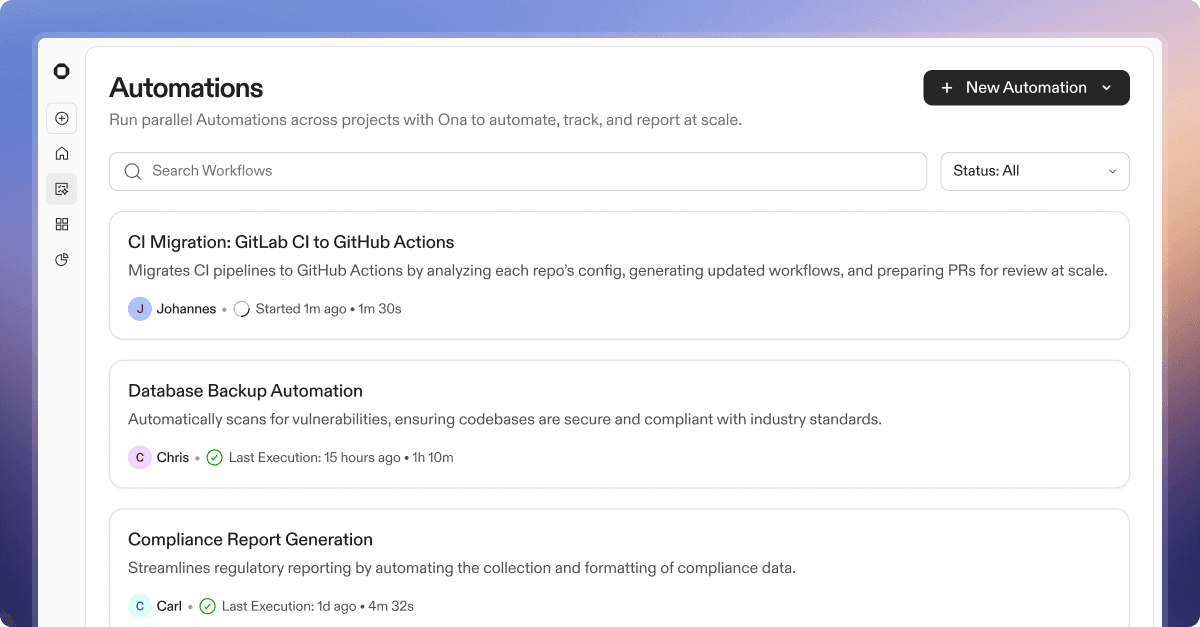
The infrastructure that enables this is:
Isolated automated environments: Each AI software engineer should run in its own secure, ephemeral environment. Ideally this is automated so each environment comes configured with all the tools, dependencies, and access it needs. You don’t want agents re-installing all their tools and suffering ‘works on my machine’ for every prompt or task.
Securely deployed orchestration: AI engineers should trigger via scheduled jobs, or event-based actions like a pushed branch for code review. Every Monday, you should be able to configure your AI software engineers to check for dependency updates across every single repo, and fully remediate if required. Those AI software engineers should be able to securely run their own tests and fix them if they’re broken.
Central policies and governance: All of this needs to run in your VPC and cloud account. Ideally no code leaves your network, you have audit trails for every action taken by your agents and a way to enforce policies globally to ensure your AI software engineers can never go rogue.
It’s time to think beyond code assistants
When people ask how a code assistant differs from an AI software engineer like Ona, the answer is that we're not trying to be a ‘better code assistant’. Code assistants are tools for individuals.
AI software engineers are infrastructure for a hybrid workforce.
This requires thinking about AI as a workforce, not just tooling. It means designing for organizational capability, not just individual efficiency. It means focusing on the 95% of legacy and maintenance work that lurks below the surface, not the 5% of code generation work that sits above. To do this, you need infrastructure that enables transformation.
If you're starting to think beyond code assistants, let's talk.
Build your hybrid workforce
Deploy AI software engineers across hundreds of repos
Related blogs
An update on Anthropic model access in Ona
What is changing now for Ona Cloud and enterprise customers

The AI adoption flywheel
Enterprise AI adoption compounds when each production win lowers the cost and risk of the next.

Beyond adoption: measure how teams do, delegate, and automate
Adoption shows who uses AI. Parallelism and automation show whether teams have changed how they work.