

- “Draw an architecture diagram showing how our microservices communicate”
- “Create a sequence diagram for the authentication flow”
- “Show me a dependency graph for the frontend components”
- “Visualize the relationships between our database tables”
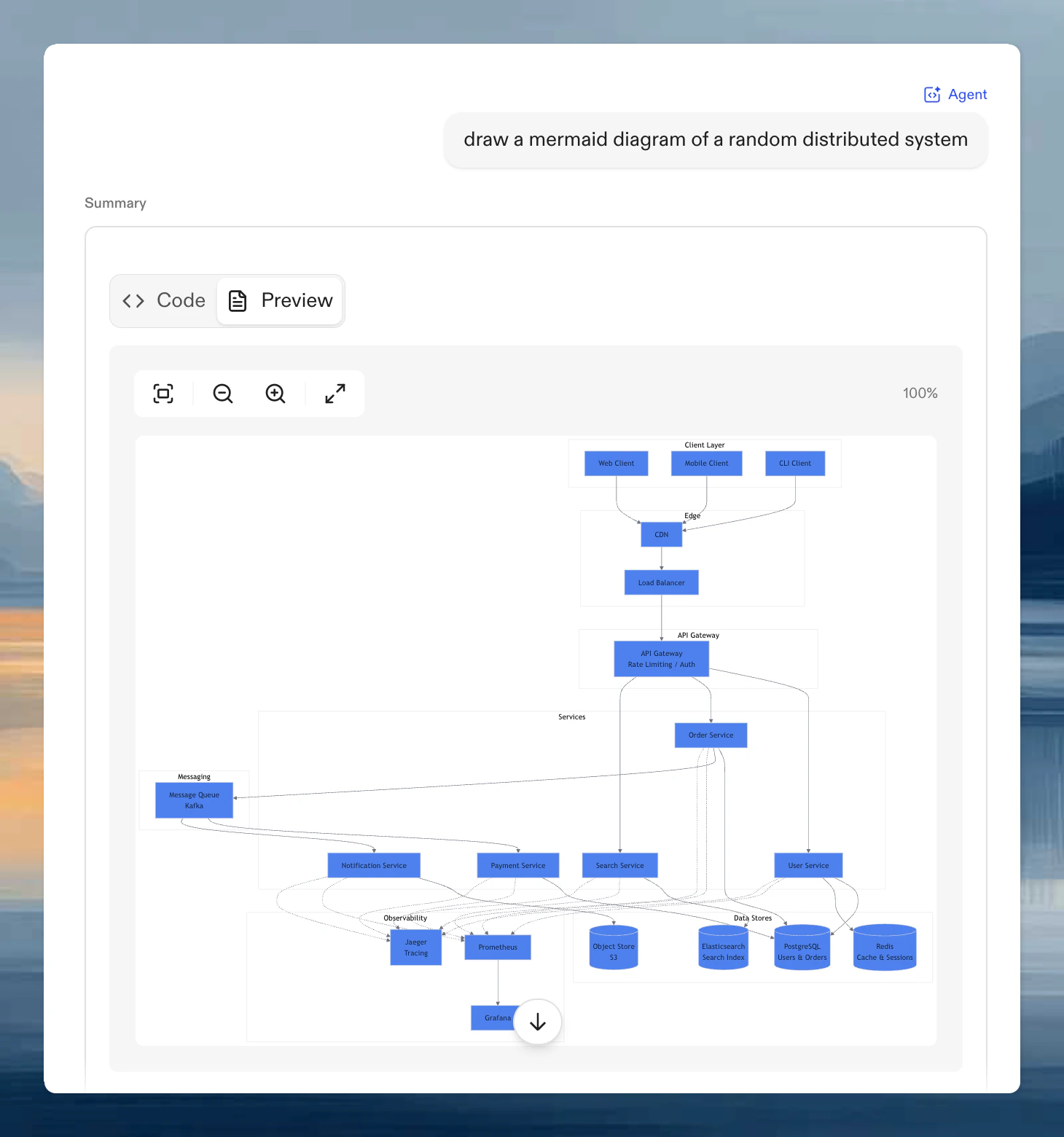
When Mermaid is useful
Mermaid diagrams help compress code or process detail into something you can scan quickly. Common use cases:- Architecture overviews for onboarding
- Sequence diagrams for request or authentication flows
- Dependency maps for refactors
- Entity diagrams for schema discussions
- Workflow diagrams for automations and pipelines
Supported diagram types
- Flowcharts: decision trees and process flows
- Sequence diagrams: interaction between components over time
- Class diagrams: object-oriented relationships
- Entity-relationship diagrams: database schema visualization
- State diagrams: state machines and transitions
- Gantt charts: project timelines
Viewing diagrams
Diagrams render with Code and Preview tabs. The preview includes zoom controls (25% to 450%), fullscreen mode, and copy-to-clipboard. Previews are static images. Diagram scripts, forms, external resources, and clickable links are disabled. Use the Code tab when you want to review or tweak the Mermaid syntax, copy the diagram into another document, or ask the agent to fix a rendering problem.Refining a diagram
The first diagram is often a draft. Good follow-up prompts include:- “Simplify this to the five most important components”
- “Turn this into a sequence diagram”
- “Group frontend, backend, and infrastructure separately”
- “Remove low-level implementation detail and focus on data flow”
Troubleshooting
Diagram Error
Diagram Error
The Mermaid syntax is invalid. Ask the agent to fix it or check the code tab for syntax issues.
Diagram is correct but not useful
Diagram is correct but not useful
Ask for fewer nodes, clearer grouping, or a different diagram type.