

The Dev Container image cache stores built images in AWS ECR, allowing environments with identical Dev Container configurations to reuse previously built images. Instead of rebuilding containers from scratch (which can take minutes), cached environments start in seconds.Documentation Index
Fetch the complete documentation index at: https://ona.com/docs/llms.txt
Use this file to discover all available pages before exploring further.
How it works
-
Hash computation: When starting an environment, Ona computes a hash based on your Dev Container configuration, including:
- Contents of
devcontainer.json - Contents of any referenced
Dockerfile - Digest of any existing container image you reference directly (ensuring automatic cache invalidation when base images like
:latestare updated)
- Contents of
-
Cache lookup: Ona checks if an image with this hash already exists:
- If found in registry: Pulls and uses the cached image
- If not found: Builds new image, pushes to registry, then uses it
- Shared caching: The cache is shared across all users within a project. The first team member who creates an environment with a new Dev Container configuration builds and caches the image. All subsequent environments created by any team member in the same project with identical configuration use the shared cached version. When rebuilding an existing environment’s Dev Container, it will also try to pull from the cache but won’t push new images (only the initial Dev Container build when an environment gets created can push to the cache).
Non-project environments (such as those started directly from a context URL) do not use the cache.
Enabling and disabling the cache
For new runners
The Dev Container image cache is enabled by default for new AWS runners.Requires Core or Enterprise plan.
For existing runners
To enable the cache for existing runners:- Upgrade your CloudFormation stack to the latest version that supports the cache
- Go to Settings → Runners in your Ona organization
- Select your AWS runner
- Toggle Dev container image cache to enabled
- Click Save
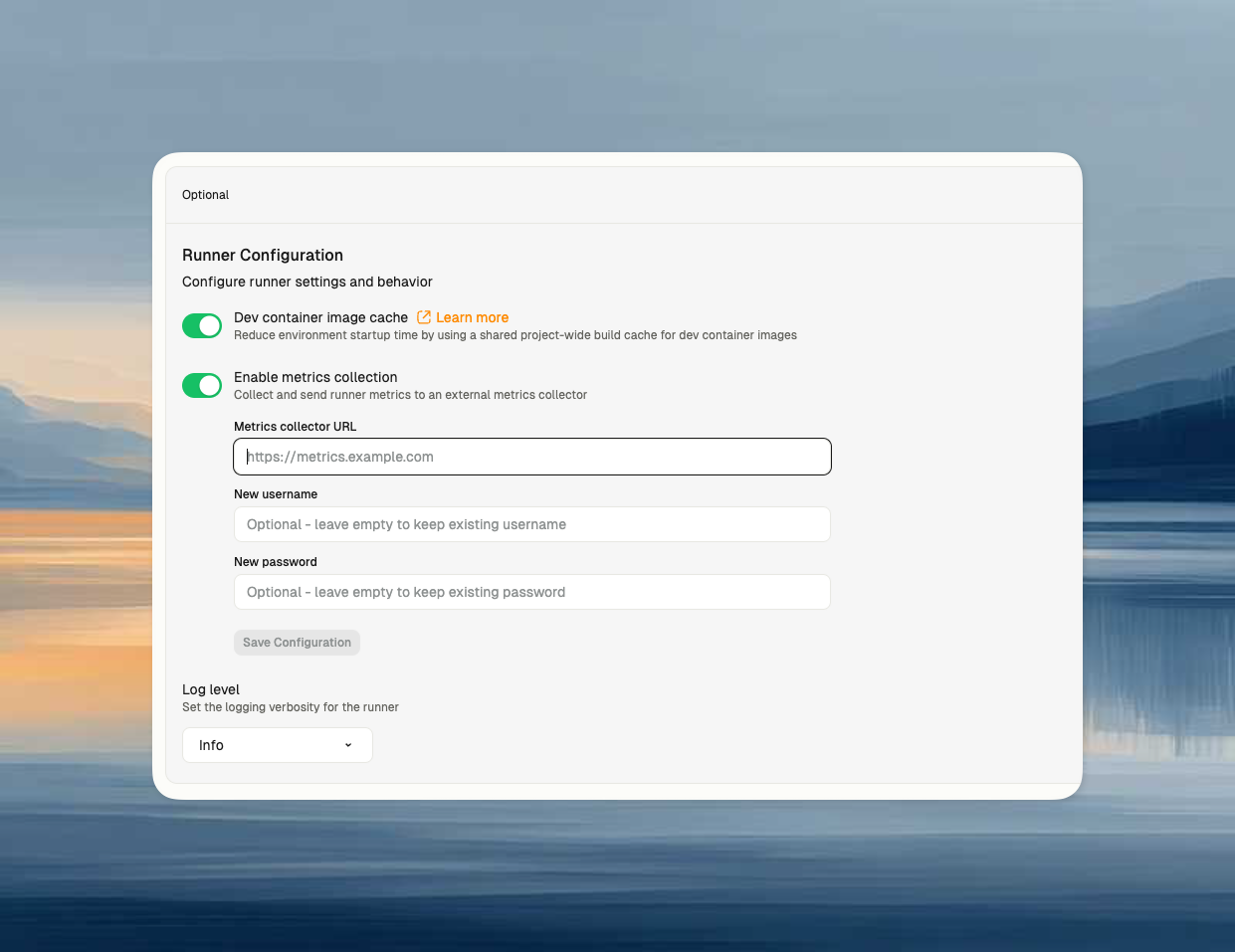
Disabling the cache
To disable caching:- Go to Settings → Runners in your Ona organization
- Select your AWS runner
- Toggle Dev container image cache to disabled
- Click Save
Disabling the cache prevents new images from being cached and stops existing environments from pulling from the cache on rebuild. Existing cached images remain in ECR until they expire (30 days) or are manually deleted.
What gets cached
The cache includes everything from adevcontainer build of your configuration:
- Base image layers: Your specified base image and any modifications
- Dev container features: All configured features are pre-installed
- Build steps: RUN commands, COPY operations, and other Dockerfile instructions
- Tool installations: Package managers, development tools, and dependencies
- Lifecycle hooks (
onCreateCommand, etc.) - these run after the container starts - User-specific configurations applied at runtime
- Files that change after container creation
Automatic cache invalidation for base images
The cache automatically detects when underlying container images are updated, ensuring you always get the latest security patches and updates without manual intervention:When referencing an existing container image
When yourdevcontainer.json directly references an existing container image:
- Automatic security updates: When the image maintainer publishes security patches, your cache is automatically invalidated
- Latest tag handling: If you use
:latesttags, the cache rebuilds whenever the latest version changes - No manual intervention: You don’t need to manually force cache invalidation when base images are updated
When building from a Dockerfile
When yourdevcontainer.json builds a custom image from a Dockerfile:
FROM statements within your Dockerfile are not automatically monitored, so you may need to manually invalidate the cache when you want to pick up base image updates.
Shared cache behavior
The cache is shared within each project:- Team efficiency: Only the first user with a new configuration experiences the full build time
- Consistent environments: All team members use identical container images
- Resource optimization: Eliminates redundant builds across team members
Enterprise security considerations
- Configuration integrity: Images are cached based on exact configuration hashes
- Limited push access: Only the initial build can push images; credentials are removed afterward
- Immutable storage: ECR prevents modification of cached images
- Project isolation: Cache access is limited to the same project
Security considerations
The Dev Container image cache implements several security measures:Access isolation
- Project-scoped access: Images are only accessible within the same project
- Hash-based immutability: Once pushed, images cannot be modified
- Credential separation: Distinct push and pull permissions
Credential management
- Push credentials: Only granted during the initial Dev Container build when an environment gets created, then removed from the environment
- Pull credentials: Provided to all environments in the project, refreshed periodically
- Temporary access: All credentials use AWS IAM temporary credentials with minimal required permissions
Registry security
- Immutable repositories: ECR repositories prevent image tampering once pushed
- AWS IAM controls: Access controlled through AWS session tags and IAM policies
- Regional isolation: Images stored in the same AWS region as your runner
Image lifecycle
Automatic expiry
Cached images automatically expire after 30 days to:- Prevent unlimited storage growth
- Ensure images are periodically rebuilt with security updates
- Reduce storage costs
Cache invalidation
A new image is built and cached when:- The Dev Container configuration hash changes (any modification to
devcontainer.jsonor referencedDockerfile) - The underlying container image changes (e.g., when
:latestor other tags are updated with security patches or new versions) - The cached image has expired
- The cached image is manually deleted from ECR
Forcing a new image build
To force rebuilding and re-caching an image, you need to change the configuration hash. You can:Method 1: Modify Dev Container configuration
Add or modify any content in yourdevcontainer.json or Dockerfile, such as:
Method 2: Add a comment to Dockerfile
If using a custom Dockerfile:Method 3: Delete the image from ECR
- Go to AWS ECR console
- Navigate to your runner’s repository:
gitpod-runner-{runnerID}/projects/{projectID}/image-build - Delete the specific image tag
- The next environment creation will rebuild and cache the image
Supported configurations
Supported
- Standard Dev Container configurations with
Dockerfileorimagereference - Dev container features from any registry
- AWS EC2 runners
- Ona Cloud
Not supported
- Docker Compose-based Dev Containers (due to limited
devcontainerCLI support) - Non-project environments (e.g. environments started directly from a context URL)
Storage and costs
Storage costs
- Images are stored in AWS ECR in your account
- Storage costs depend on image size and number of unique configurations
- 30-day automatic expiry helps manage costs
- ECR repositories inherit all tags from the CloudFormation stack (useful for cost allocation and AWS MAP programs)
Cost optimization
- Similar Dev Container configurations share base layers, reducing storage
- Regional storage (same region as runner) minimizes transfer costs
- Automatic expiry prevents accumulation of unused images
Repository location
Cached images are stored in ECR repositories with the naming pattern:gitpod-runner-{runnerID}/projects/{projectID}/image-build
Each project gets its own repository within the runner’s ECR namespace, ensuring proper isolation and organization.
Monitoring
Cache hits are logged during environment creation:Troubleshooting
Cache not working
Cache not working
If images aren’t being cached:
- Check runner configuration: Ensure the Dev Container image cache is enabled in runner settings
- Verify CloudFormation version: Older CloudFormation templates don’t support caching
- Check AWS permissions: Ensure the runner has ECR access permissions
- Check runner logs: Look for cache-related errors in the runner’s CloudWatch logs
- Review environment logs: Look for cache-related error messages
- Check image digest warnings: If using
image:field, look for digest lookup warnings in logs that might indicate network or authentication issues with base image registries
Slow startup despite cache
Slow startup despite cache
If environments are still slow to start:
- Check cache hit: Look for “Using pre-built dev container” in environment logs
- Verify image size: Large images take longer to pull
- Check environment type: Docker Compose-based Dev Containers are not supported by the cache
- Review lifecycle hooks: Lifecycle hooks (
onCreateCommand, etc.) are not cached and may install tools that increase startup time. Consider moving these steps to the Docker build where possible - Verify project-based environment: Non-project environments do not use the cache